
What you’re about to learn in this module is exactly what top independent college counselors walk their families through. The ones charging $5,000 to $50,000 per student. The discovery exercises, the intersection mapping, the validation frameworks — same playbook, different price tag. We know because we’ve been on the other side of that desk. We’ve written those checks. We’ve done the worksheets. And we walked away thinking: Why is this locked behind a five-figure paywall? The information isn’t complex. It’s gatekept. Wrapped up in boutique consulting firms that have zero incentive to share what they know. The whole “admissions is a mysterious black box” thing? It exists because keeping it mysterious is profitable for certain people.We’re not those people. We’re parents who’ve been through the process, paid the money, and got the t-shirt. We think this should be available to every family — not just the ones who can drop $50K on a counselor who tells them what we’re about to tell you right now. Same framework. Free. No NDA required. This module walks through the entire IMPACT Method across three chapters — Explore, Connect, and Build — plus a closing chapter on pitfalls and pivots. This chapter covers the Explore phase: figuring out what your child actually cares about and finding problems worth their time.
In this chapter:
- Why most “passion projects” crash and burn on the admissions test — and the conversation we have with parents every single week that explains why
- The full IMPACT Method: a 6-step framework for going from “my kid likes stuff” to “my kid built something colleges can’t ignore”
- Step I: How to uncover your child’s real interests (hint: “What subjects do you like?” is a useless question)
- Step M: Finding problems worth solving — specific, verifiable, meaningful, and doable
Why Most “Passion Projects” Fail the Admissions Test
Here’s a conversation we have with parents at least once a week: Parent: “My daughter is passionate about environmental issues, but she doesn’t know what project to do that will actually impress colleges.” Us: “What specifically about environmental issues interests her?” Parent: (long pause) “Um… saving the planet?” And that’s the problem. When we dig deeper, we typically discover the student doesn’t actually have a specific environmental passion — they just think “environmental leadership” sounds good on applications. Even when students DO have genuine interests, most parents and counselors give terrible advice about how to transform those interests into compelling projects. The result? Generic, forgettable projects that fail to demonstrate the qualities that top colleges are actually looking for. Think about it through the investor lens from Chapter 1.4. “I’m passionate about the environment” is a pitch deck with no traction. “I built a composting system that diverted 80% of my school’s food waste and got adopted by 12 other schools” is a startup with revenue. Same domain. Different planet. Or run it through the from Chapter 2.1. “Passionate about the environment” is Level 1 at best. It’s participation. It’s showing up. It generates zero evidence of depth, impact, or initiative — the three components from Chapter 2.3 that separate real spikes from manufactured ones. The gap between “interested in X” and “built something meaningful in X” is where families lose the plot. And it’s a big gap. Most people try to cross it by googling “impressive extracurriculars” at 11pm and picking something that sounds good. That doesn’t work. The IMPACT Method does.The IMPACT Method: Your Roadmap to a Killer Spike
After working with hundreds of students (including our own kids) who’ve been accepted to elite universities, we’ve developed a systematic 6-step framework for helping students develop college-worthy project ideas. We call it the IMPACT Method. Six steps. Three phases. Three chapters. Here’s where everything lives: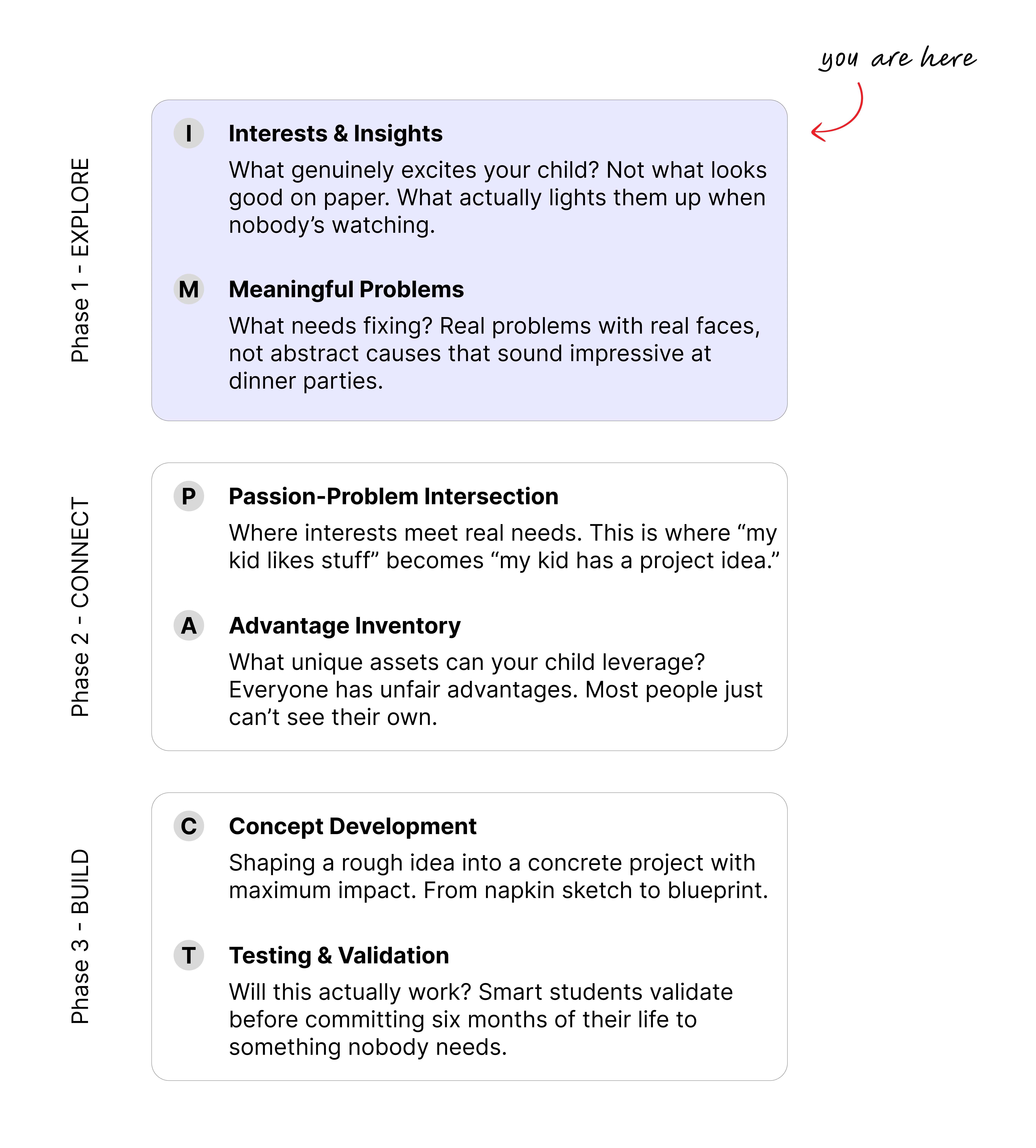
Step I: Uncover Their TRUE Interests & Insights
Forget asking your kid “What subjects do you like?” That gets you nowhere fast. Seriously. Try it at dinner tonight. You’ll get a shrug, a mumbled “I dunno, science I guess,” and a request to pass the salt. That response tells you exactly nothing — because teenagers are spectacularly bad at articulating what they actually care about. They’re even worse at distinguishing between “things I genuinely lose myself in” and “things I think adults want to hear.” So stop asking. Start watching. Instead, play detective:1
Track their flow states
When do they lose track of time? What YouTube rabbit holes do they fall into at 2AM? These unconscious patterns reveal their real passions.
2
Listen for the rants
What gets them fired up? The issues they complain about often hide their deepest interests.
3
Look beneath the surface
Your “video game obsessed” teen might actually be passionate about world-building or narrative design, not just gaming.
The Resume Interest Trap
If your child picks an interest because it “looks good on applications,” the project is dead on arrival. Admissions officers have read ten thousand essays about students who suddenly discovered a passion for cancer research the summer before junior year. They can smell performative interest from a paragraph away. The whole point of Step I is to find what’s real — even if it seems weird, niche, or unmarketable. Weird and genuine beats polished and fake. Every time.Exercise: The Flow State InventoryThis week, observe your child and enlist them in the process. Track these patterns:
- Flow moments: When do they lose track of time? What are they doing when you have to call their name three times before they hear you?
- The 2AM test: What do they read, watch, or tinker with when nobody’s assigning it?
- The rant test: What topics make them talk faster, gesture more, or get visibly frustrated? What injustices or problems set them off?
- Beneath the surface: For each interest you identify, dig one layer deeper. “Likes gaming” — what about gaming? “Likes art” — what kind of creative problem-solving? “Likes science” — which specific questions keep them up at night?
Step M: Find Problems Worth Solving
You’ve got a list of genuine interests. Good. Now here’s where most families blow it: they jump straight from “my kid likes environmental science” to “let’s start a nonprofit!” No. Slow down. An interest without a problem is a hobby. Hobbies are great. Hobbies don’t get people into Princeton. The difference between forgettable and compelling projects? Solving real problems that matter to real people. Not theoretical problems. Not problems you read about in a textbook. Problems with faces. Problems with names. Problems you can walk outside and trip over. Help your teen find problems that are:- Specific (not “hunger” but “food waste in school cafeterias”)
- Verifiable (backed by real evidence — you can see it, measure it, talk to people affected by it)
- Meaningful (solving it would actually help people — not a solution in search of a problem)
- Doable (a high schooler could realistically tackle it — not “cure cancer” but “improve medication tracking for seniors at one clinic”)
The Three Circles: Map Problems in Your World
If your child says “I don’t know what to work on” — good news. There’s an exercise for that. Grab a piece of paper and draw three circles. Label them:1
Personal
Issues affecting your child or their friends directly. What frustrates them at school? What’s broken in their daily life? What do their friends complain about constantly?
2
Community
Problems in their school, neighborhood, or town. Who’s being overlooked? What resources aren’t reaching the right people? What does everyone grumble about but nobody fixes?
3
Systemic
Bigger issues they care about. Not “world hunger” big — more like “food insecurity in our county” big. Large enough to matter, specific enough to approach.
Key Insight: The best spike-worthy problems aren’t found in textbooks or on “top global issues” lists. They’re found in your child’s actual life — their school hallway, their neighborhood, their family’s dinner table conversations. When the problem is personal, the motivation to solve it is built in. And built-in motivation is the thing that keeps a student grinding at month six when the excitement has evaporated and the work hasn’t.
Exercise: The Three CirclesSit down with your child for 20-30 minutes. This should feel like a conversation, not a homework assignment.
- Draw three circles labeled Personal, Community, and Systemic
- In each circle, list 3-5 specific problems (run them through the four-quality filter: specific, verifiable, meaningful, doable)
- For each problem, jot down: Who’s affected? How badly? Is anyone else working on this?
- Star the problems that overlap with interests from Step I — where your child both cares about the problem AND has genuine interest in the domain
Interests Found. Problems Mapped. Now What?
If you’ve worked through the two exercises in this chapter — the Flow State Inventory and the Three Circles — you’re already ahead of the vast majority of families. Most parents skip this entire exploration phase. They jump straight from “my kid needs a spike” to googling “impressive extracurriculars for college” at 11pm and picking something that sounds good on paper. You didn’t do that. You did the actual work. You now have:- A clearer picture of what your child actually cares about — not what they think sounds impressive, but what genuinely pulls them in
- A map of real, specific problems worth solving in their world
Key Takeaway: The gap between “my kid is interested in stuff” and “my kid has a spike” starts with honest exploration — not with picking a project off a list. Track the flow states (Step I). Map the real problems (Step M). Most families skip this process and jump straight to “what project should we do?” which is exactly why most passion projects fail the admissions test. The exploration comes first. Everything else builds on it.
Your Assignment: Complete the Explore PhaseThis week, work through both exercises with your child:
- Flow State Inventory (Step I): Track your child’s genuine interest patterns. Identify 3-5 real interests beneath the surface labels. Use the Midnight YouTube Test, the Rant Test, and the Beneath-the-Surface dig.
- Three Circles (Step M): Map specific, solvable problems in your child’s personal, community, and systemic worlds. 3-5 problems per circle, filtered through the four qualities (specific, verifiable, meaningful, doable).
Coming up next: You’ve discovered what your child cares about and mapped the problems worth solving. In Finding Your Sweet Spot, we cover the Connect phase of the IMPACT Method — finding the intersection where passion meets real problems (Step P), complete with the Venn Diagram of Opportunity and Connection Matrix, plus identifying the unique advantages that give your child an edge nobody else has (Step A). Exploration gave you raw material. Connection gives you direction.