
- A 30-minute evidence audit you can do with your teen this weekend
- A scoring grid to map every activity against the pyramid
- The coding club transformation — how one basic activity becomes a compelling spike across all five levels
- Four specific strategies for climbing from each level to the next, with real before/after examples
- Lucas’s story: how a “looks good on paper” resume got rewritten into a compelling evidence stack
Show, Don’t Tell
College admissions officers aren’t just tallying clubs or hunting for fancy titles. They’re looking for proof of impact. Think your kid is amazing? Great! So do thousands of other parents. What makes admissions officers believe you? Evidence. This proof falls on a spectrum — from “I showed up” (yawn) to “I changed my community” (hello, acceptance letter!). Getting this hierarchy isn’t just helpful — it’s your secret weapon for spotting where your teen’s application shines or needs serious help. And that’s exactly what you’re about to do. The Evidence Pyramid from the previous chapter gave you the framework. Now you’re going to hold your child’s activities up against it — honestly, systematically, and with the clarity of someone who finally knows what admissions officers are actually looking for.Your 30-Minute Evidence Audit
Grab your teen and a cup of coffee. In just half an hour, you’ll uncover the truth about their college application — strengths, weaknesses and all.Ask the Three Tough Questions
- What actual proof do they have? (Hint: “Trust me” isn’t proof)
- How impressive would this evidence be to a skeptical admissions officer?
- Where can they level-up their evidence game?
Score Each Activity on the Pyramid
- Level 1 — Participation: “I showed up”
- Level 2 — Achievement: “I got recognized”
- Level 3 — Character: “I walked the walk”
- Level 4 — Leadership: “I made things happen”
- Level 5 — Impact: “I changed something”
Spot the Trends
- Which activities have “level-up” potential for better evidence?
- Where is your teen this close to showing real impact?
- Which impressive-sounding activities are actually evidence duds?
Your Evidence Grid
Here’s a simple tool to organize your audit. For each of your child’s top three activities, work through these four rows: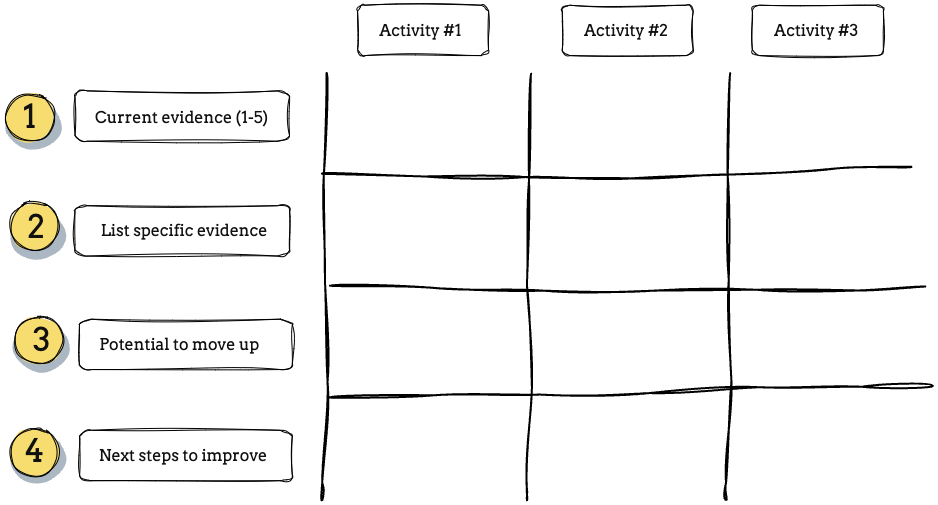
The Evidence Grid — your 30-minute audit tool
The Coding Club Transformation
Let’s see how the Evidence Pyramid transforms an ordinary activity into a compelling :Before: The Basic Activity
Activity: Started a coding club at school
Position: Founder and President
Time Commitment: 3 hours/week for 2 years
This looks fine on paper, but it’s forgettable. Thousands of students have “Founded and led a coding club” on their activities list. An admissions officer reads it, nods, and moves on. There’s nothing here that separates your child from the next application in the pile.
After: The Evidence-Stacked Spike
Level 1 (Participation): Created “Code for Change,” a student organization that develops free websites for local nonprofits. Built a structured curriculum and project management system that guides students through the entire development process.
Level 2 (Achievement): Selected as one of 20 student-led organizations nationwide to receive the Microsoft Community Tech Grant. Featured in local newspaper and invited to present at the State Education Technology Conference.
Level 3 (Character): Developed a 10-module curriculum that teaches both technical skills and client management. Created assessment tools that track student progress from beginner to advanced developer.
Level 4 (Leadership): Implemented a mentorship system where experienced members coach newcomers, with special outreach to underrepresented groups in tech. 40% of current members are female (compared to 15% in typical coding programs).
Level 5 (Impact): Completed websites for 12 local nonprofits, helping them collectively raise over $50,000 in additional donations. Expanded to three neighboring schools, with 60+ students now participating across the district.
How to Climb the Hierarchy
Here’s the game-changing reality: most students get stuck at the bottom of the evidence hierarchy, fighting for attention with thousands of other “club members” and “participants.” But with the right strategy, your child can systematically climb to the top — where competition thins out and impact speaks louder than any fancy title. These aren’t just theoretical suggestions — they’re battle-tested strategies that have helped students stand out in an increasingly competitive landscape. Each transition below maps directly to the pyramid levels you learned in the previous chapter. And if you’re thinking in investor terms from Chapter 1.4, you’ll notice something: as your child climbs the pyramid, they naturally start generating the signals investors look for — exponential growth, scalable impact, and market validation. The pyramid and the investor lens are two views of the same reality.Participation → Achievement
Strategy 1: Set Concrete Goals- Don’t just “join the robotics club” — set a goal like “I want to learn Python and build a working robot that can navigate a maze by the end of semester”
- Keep a weekly log of what you actually did and learned — just saying “I practiced a lot” won’t cut it
- Look for competitions, certifications, or badges that prove you know your stuff — concrete proof beats vague claims
- Find that one thing nobody else is doing — maybe you’re the only one who knows how to calibrate the lab equipment or edit videos
- Put in focused practice time — 30 minutes daily beats 4 hours of cramming once a month
- Show off what you can do — volunteer to teach others, enter competitions, or post your work online
- Before: Member of school environmental club
- After: Certified in water quality testing; conducted monthly analyses of local watershed with published results
Achievement → Leadership
Strategy 1: Create Value Before Seeking Titles- Be the person who fixes annoying problems — if club meetings are chaotic, create an agenda template everyone can use
- Make others’ lives easier — create that spreadsheet nobody wanted to make, or write up that guide for new members
- Become the go-to person by actually helping, not just raising your hand for every volunteer opportunity
- Take charge of one small thing and crush it — maybe it’s organizing one event or managing the club’s social media
- Keep notes on what worked and what flopped — failed bake sale? Write down why so the next person doesn’t repeat your mistakes
- Ask for more responsibility only after you’ve nailed the small stuff
- Before: Award-winning debater on the school team
- After: Created and led a six-week training program that improved novice debaters’ win rates by 40%
Leadership → Initiative
Strategy 1: Identify Gaps and Needs- Play detective — what makes people groan or complain? That’s your opportunity
- Actually talk to people — grab coffee with the club advisor, chat with other students, DM alumni on LinkedIn
- Look for quick wins — sometimes the biggest impact comes from fixing small but super annoying problems
- Start super small — test your idea with five people before trying to change the world
- Ask for brutal honesty — “what sucks about this?” is more useful than “do you like it?”
- Keep a project journal — what went wrong, what surprised you, what you’d do differently next time
- Before: President of the school’s community service club
- After: Created a digital platform matching student volunteers with seniors needing technology help, serving 200+ elderly residents
Initiative → Impact
Strategy 1: Define Clear Impact Metrics- Get specific with your numbers — “helped students” is weak, “improved test scores by 23%” is strong
- Take “before” pictures — you can’t show improvement if you don’t know where you started
- Build tracking into your project from day one — create simple Google Forms or spreadsheets to collect data as you go
- Figure out which parts of your project actually work — maybe only 2 of your 5 strategies are driving 90% of results
- Create cheat sheets and templates — make it brain-dead simple for others to copy what works
- Make friends with people who can help you grow — other club leaders, teachers, local nonprofits, anyone who might want to use your solution
- Before: Started a peer tutoring program at school
- After: Developed a structured curriculum and training system that improved participating students’ grades by an average of 27%; program adopted by three other schools in the district
Lucas’s Story: From “Looks Good on Paper” to Standout Evidence
Case Study Lucas came to us with the classic “looks good on paper” resume: Model UN, varsity athlete, fancy Ivy League summer program. But our evidence audit showed a harsh truth — he was stuck in the land of “so what?” evidence. Meanwhile, his weekend obsession with stop-motion animation videos? Nowhere on his resume. We helped him flip the script. He created free animation workshops for kids with learning disabilities, built a curriculum that taught storytelling through animation, and tracked a 40% jump in narrative skills among the children. He even trained other teens to run similar programs. That “just-for-fun” hobby? It became his application superstar — showcasing creativity, leadership, and measurable results. The result was a profile that admissions committees couldn’t ignore. Here’s what the audit revealed — and what the transformation looked like on the pyramid:- Before the audit: Model UN (Level 1 — participation), varsity athletics (Level 2 — achievement), Ivy League summer program (Level 1 — participation, despite the price tag). Impressive titles, thin evidence. Every activity sat at the bottom of the pyramid, indistinguishable from thousands of other applications.
- After the flip: Animation workshops for kids with learning disabilities (Level 4 — leadership and initiative), a curriculum teaching storytelling through animation (Level 3 — character, walking the walk), a 40% jump in narrative skills (Level 5 — measurable impact), training other teens to run similar programs (Level 5 — replication and scale).
The Real Difference
This chapter asked you to do something most families never do: look honestly at the evidence, not the activities. Most families optimize for how things look. They chase impressive-sounding programs, leadership titles, and long activity lists. But admissions officers aren’t evaluating how things look — they’re evaluating what things prove. The evidence audit flips your perspective. It’s not “what is my child doing?” It’s “what can my child prove?” And once you see the gaps, you can fill them — strategically, deliberately, one level at a time.- Print or recreate the Evidence Grid for your child’s top 3-5 activities
- Sit down with your teen (coffee optional, honesty required) and work through each activity:
- Score it on the pyramid (1-5)
- List the specific, concrete evidence it has generated
- Assess the potential to climb higher
- Identify one next step for each activity
- Look for patterns across the grid:
- Are most activities stuck at the same level?
- Which activity has the most natural potential to reach Level 4-5?
- Are there any “evidence duds” consuming significant time?
- Do any activities connect to each other in ways that could create an evidence stack?
- Circle your child’s best candidate for a spike — the activity with the most authentic interest AND the most room to climb