
In this chapter:
- The unspoken hierarchy of evidence admissions officers use — and why most families have never heard of it
- Five levels from weakest (participation) to strongest (impact), with concrete examples at each
- Why most families are pouring resources into the lowest levels while the upper levels sit wide open
- How “evidence arbitrage” gives strategic families an unfair advantage
- Sophia’s transformation from talented musician to a standout evidence stack
The Case for Evidence
Let’s start with a reality check. Every year, thousands of students with perfect GPAs, impressive extracurriculars, and heartfelt essays get rejected from top colleges. Why? Because their applications lack something crucial: credible evidence of future potential. Or at best, they provide thin, unconvincing evidence that doesn’t stand up to scrutiny. As we covered throughout Module 1, compelling evidence of a has at least three essential components:- Depth – Sustained engagement that demonstrates mastery
- Initiative – Self-directed action that shows leadership
- Impact – Measurable results that affect others
The Evidence Pyramid
After working with hundreds of students who’ve been accepted to elite colleges, we’ve developed a framework we call “The Evidence Pyramid.” This approach systematically builds layers of credible evidence that reinforce each other, creating an application that’s impossible to dismiss. We call this process . Think of it like a courtroom. You’re making a case — the case that your child is worth one of those 1,600 spots at Harvard or 1,700 at Stanford. The question isn’t whether they’re talented. The question is: what’s your evidence? And just like in a courtroom, some evidence is hearsay and some is a smoking gun. The pyramid tells you which is which. Here’s how it works: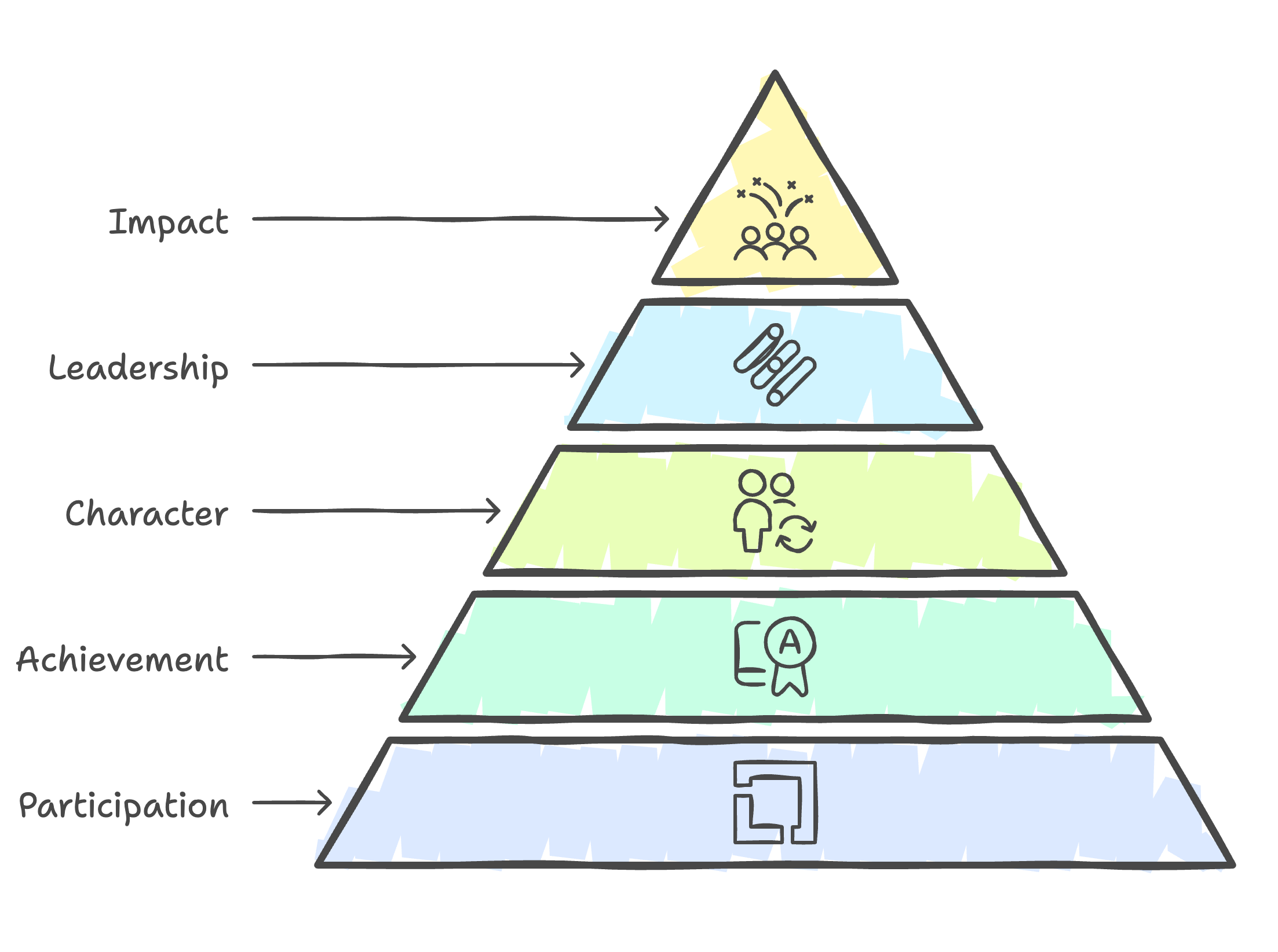
Achievement — “I got recognized”
Character — “I walked the walk”
Leadership — “I made things happen”
Impact — “I changed something” Each level carries exponentially more weight than the one before it. The vast majority of students — including very talented, hardworking ones — never get above Level 2.
Level 1: Participation (Weakest)
This is the most common type of evidence — and the least impressive.- Being just another club member
- Showing up to volunteer (without making an impact)
- That fancy summer program you attended
- One-and-done activities you never stuck with
Level 1 Evidence
“Joined a nonprofit”
What Stands Out
“Built a food delivery system that got 10,000 meals to homeless families in 18 months”
Level 1 Evidence
“Volunteered at hospital”
What Stands Out
“Created a new patient check-in system that cut waiting time by 32% (and the hospital still uses it!)”
Every year, admissions officers reject thousands of applications stuffed with club memberships and volunteer hours. Your job? Show what you actually built, created, or made happen. Show them you’re a doer, not just a joiner.
Level 2: Achievement
Here’s the thing about basic achievements: they’re better than just participating in things, but they won’t make you memorable. They show you can play by the rules, but colleges want to see that you can change the game. The Just-OK Stuff (basic achievements):- Honor roll (Yeah, it’s good, but pretty standard)
- Sports letters and team captaincies
- School leadership positions
- First chair violin
- Those “student of the month” certificates
- Experts saying you’re legit (Think: real organizations giving you awards)
- Your work making headlines (Local news, industry blogs, etc.)
- Experts actually using your stuff (Like when a hospital adopts your check-in system)
- Getting selected for truly competitive spots (Not those “pay-to-play” opportunities)
Level 2 (Basic)
“Won school science fair”
Level 2 (Validated)
“EPA actually used my microplastic filtration research (and now the county water treatment plant is using it too!)”
Level 2 (Basic)
“Made honor roll all four years”
Level 2 (Validated)
“My research paper on local pollution got published in an environmental journal and led to city policy changes”
- Would someone who doesn’t love you be impressed?
- Did you earn this, or did it come gift-wrapped?
- Could someone with enough money just buy this achievement?
- Would this make an expert in the field say “huh, interesting…”?
Level 3: Character
This is where things start getting interesting — and where most families have a massive blind spot. Levels 1 and 2 are about what your child did. Level 3 is about who your child is. And admissions officers are paying much closer attention to this distinction than most families realize. Are you actually someone who makes things better wherever you go? If so, then tell them about it. No humble-bragging needed — just real examples of walking the walk. What Colleges Are Actually Looking For:- Living your values (not just talking about them)
- Doing the right thing (even when it’s the hard thing)
- Bouncing back from face-plants (because everyone falls — it’s the getting up that counts)
- Sticking with what matters (not just chasing the next shiny thing)
Says It
“I’m passionate about inclusion”
Shows It
“Noticed our robotics competitions left out kids with physical disabilities, so I designed adaptive controllers and convinced three regional competitions to change their rules”
Says It
“I believe in standing up for others”
Shows It
“Started getting to school early to hang out with the kid everyone ignored at lunch. Now there are 12 of us at that table.”
- Problem-spotting superpower: You identify issues others walk past daily — like noticing your school’s recycling “program” is just for show and then designing a real solution
- Self-initiated impact: You don’t wait for permission or assignment — you see a need and create the fix before anyone asks
- Community catalyst: You transform personal projects into movements that inspire others to join your cause (and stick around)
- Resilience through the boring parts: You demonstrate the rare ability to push through when the excitement fades and the hard work begins — the quality that separates dreamers from achievers
Level 4: Leadership
Now we’re entering rare air. Levels 4 and 5 are where applications go from “strong” to “we need to admit this student.” And here’s why: the competition thins out dramatically. While thousands of applicants crowd Levels 1 and 2, relatively few can demonstrate genuine Level 4 leadership. The supply-demand math works in your favor here — if your child can get here. Anyone can call themselves a leader. What colleges really want to see is that you actually made things happen and got other people excited to follow along. What Makes Colleges Roll Their Eyes:- Starting a club just to be president (they’ve seen this 1000 times!)
- Leading something that never actually did anything
- Taking credit for stuff your teacher/coach really did
- Having a fancy title but no real impact
- Team captain who transformed practice culture, not just ran drills
- Club president who doubled membership and launched cool projects
- Section leader who created a mentoring system that stuck
- Peer tutor who helped others crush it (and can prove it!)
Title Without Impact
“Founded and led the Environmental Club”
Leadership With Results
“Got 75% of students composting at lunch by making it fun and easy (cafeteria waste down 40%!)”
Title Without Impact
“Captain of debate team”
Leadership With Results
“Rebuilt the debate team from 4 to 24 members and took us to states for the first time in 10 years”
- Did things actually get better because you were in charge?
- Would your team members say you made their lives easier?
- Can you point to specific changes you made?
- Will your improvements last after you graduate?
Level 5: Impact (Strongest)
This is the summit. Level 5 evidence is what makes admissions officers walk into committee meetings with a folder in hand and say, “I’m going to bat for this kid.” And here’s the beautiful thing about Level 5: almost nobody is here. Not because it’s impossibly hard, but because most families don’t even know this level exists. They’ve been told the game is about GPAs and activities and leadership titles — and so the entire crowd is jammed into Levels 1 through 3, fighting for attention in the most competitive space imaginable. Level 5 is comparatively empty. The students who get here have the field almost to themselves. Colleges aren’t impressed by what you planned to do or tried to do. They want to see what actually happened because you showed up. This is where you prove that you created meaningful, measurable change with cold, hard facts. What Counts as Real Impact:- Quantifiable Results That Tell a Story — Not just “Increased attendance by 47%” but “Created a new outreach strategy that boosted attendance from 34 to 50 students per session, enabling us to help 215 more students master calculus this year”
- Authentic Testimonials That Validate Your Work — Collect specific statements from beneficiaries, mentors, or organizations about exactly how your work made a difference: “The hospital director wrote that my patient navigation app ‘revolutionized how we support families during treatment’”
- Before/After Transformations With Evidence — Document the initial problem with data, then showcase the improvement: “When I started, only 6% of students recycled correctly. After implementing my color-coded system and education program, proper recycling hit 78% and reduced our school’s landfill contribution by 2.1 tons annually”
- Replication and Adoption by Others — The ultimate validation is when established organizations implement your ideas: “My peer mental health support protocol was adopted by 3 neighboring school districts and is now being piloted statewide”
- Using vague descriptions (“helped lots of people”)
- Stretching the truth or making claims nobody can verify
- Taking credit for the whole team’s work
The Power of Evidence Arbitrage
Here’s the strategic insight that ties this entire framework together — and it might be the most valuable concept in this course: The college admissions game is fundamentally about . Most families are investing enormous resources to generate low-value evidence (participation in expensive programs, leadership titles in standard activities) while completely overlooking opportunities to create high-value evidence (measurable impact in overlooked areas). The smartest applicants aren’t working harder — they’re working higher on the evidence hierarchy. Think about what this means practically. Thousands of families are spending $5,000–$15,000 on summer programs that generate Level 1 evidence. Thousands more are pushing their kids into leadership positions that top out at Level 2. Meanwhile, Levels 4 and 5 — where the real admissions power sits — are comparatively wide open. Not because they’re easy, but because most families don’t even know these levels exist. That’s arbitrage. You’re investing where the competition is thinnest and the returns are highest. This is the same logic an investor would use. Don’t compete in a crowded market with slim margins. Find the overlooked opportunity with asymmetric upside. In Module 1, you learned to think like an investor. The Evidence Pyramid shows you where to invest.Sophia’s Story: From Talented Musician to Standout Evidence Stack
Case Study When Sophia came to us, she had been playing violin for 10 years and was quite accomplished. But her application evidence was thin — just a list of performances and competitions. We helped her audit her evidence stack and found major gaps in Levels 3 and 5. To strengthen her impact evidence, she created a music therapy program at a local children’s hospital and documented how it reduced anxiety scores in pediatric patients by 30%. To build character evidence, she started a scholarship fund for low-income students to access music lessons, raising $15,000 and creating a sustainable funding model. These additions transformed her application from “talented musician” to “innovative leader using music to create meaningful change.” Her profile became the kind of application admissions committees lean into. Let’s map what happened against the pyramid:- Level 1 (Participation): Ten years of playing violin. ✓ Already had this.
- Level 2 (Achievement): Accomplished performer with competition credentials. ✓ Already had this.
- Level 3 (Character): Created a scholarship fund for low-income music access — living her values, not just talking about them. ✓ Added this.
- Level 4 (Leadership): Built and ran a music therapy program at a children’s hospital. ✓ Added this.
- Level 5 (Impact): Documented a 30% reduction in patient anxiety scores. Sustainable funding model that outlives her involvement. ✓ Added this.
The Real Difference
Most parents focus on helping their kids “get into” activities that sound impressive. Smart parents focus on helping their kids “get evidence” from activities they’re already doing. The truth is, almost any genuine interest can become a compelling spike with the right evidence stack. Your child doesn’t need to cure cancer or start a million-dollar business. They just need to create multiple layers of credible evidence that tell a coherent story about their potential. The most successful applications we’ve seen didn’t come from students doing extraordinary things — they came from students who documented ordinary things extraordinarily well.Key Takeaway: The Evidence Pyramid isn’t about doing more — it’s about doing higher. Most families are stuck generating Level 1–2 evidence while Levels 4–5 sit wide open. The strategic move is evidence arbitrage: invest your child’s limited time and energy at the levels where competition is thinnest and admissions impact is highest. Almost any genuine interest can produce Level 5 evidence with the right approach.
Your Assignment:Take your child’s three most significant activities — the ones they spend the most time on — and identify where each one currently sits on the Evidence Pyramid:
- What’s the highest level of evidence each activity has generated so far?
- Which activities are stuck at Level 1–2 despite significant time investment?
- Which activity has the most natural potential to generate Level 4–5 evidence?
Up next: Your Evidence Audit — a practical 30-minute tool that turns the Evidence Pyramid into a personal diagnostic. You’ll audit every activity on your child’s profile, spot the hidden gold (and the evidence dead-ends), and see exactly how to climb from one level to the next. Grab your teen and a cup of coffee — this one’s hands-on.